A tunic is the most forgiving top you can wear to an office, and also the easiest one to get wrong. The extra length gives you coverage and room to move, but it also hides your waist and can swallow a small frame if the trousers underneath are loose too. Nearly every look below follows one rule I use with workwear clients: if the top is long and relaxed, the bottom stays narrow, and if you want wider trousers, the tunic gets shorter or picks up a belted tunic shape at the waist. Fabric decides the rest. Poplin, crepe and fine knits read as office clothes, while thin jersey reads as a long T-shirt no matter what you pair it with.

How Long a Work Tunic Should Actually Be
The length of a tunic decides almost everything else about the outfit, so I check it before color or fabric. For office wear, the useful range runs from the bottom of your seat to around mid-thigh. Shorter than that and it is simply a long top. Longer than mid-thigh and it starts to behave like a dress, which only works over very narrow trousers.
Petite frames look best with the hem at the top of the thigh, because every extra centimetre of tunic takes a centimetre of visible leg. If you're tall, a longer hem with side slits keeps the proportions in balance and stops the top from looking cropped on you.
The test I always do is the chair test. Sit down in front of a mirror and look at three things:
- Whether the hem bunches into folds on your lap. A little is normal; a thick roll means the tunic is too long or too stiff for desk work.
- Whether the side slits open above your waistband, which shows the top of your trousers every time you lean forward.
- Whether the back rides up and leaves your waistband visible when you reach for a keyboard.
A tunic that passes all three is one you'll actually wear all day without adjusting.
1. White Tunic Top With Black Ankle Pants
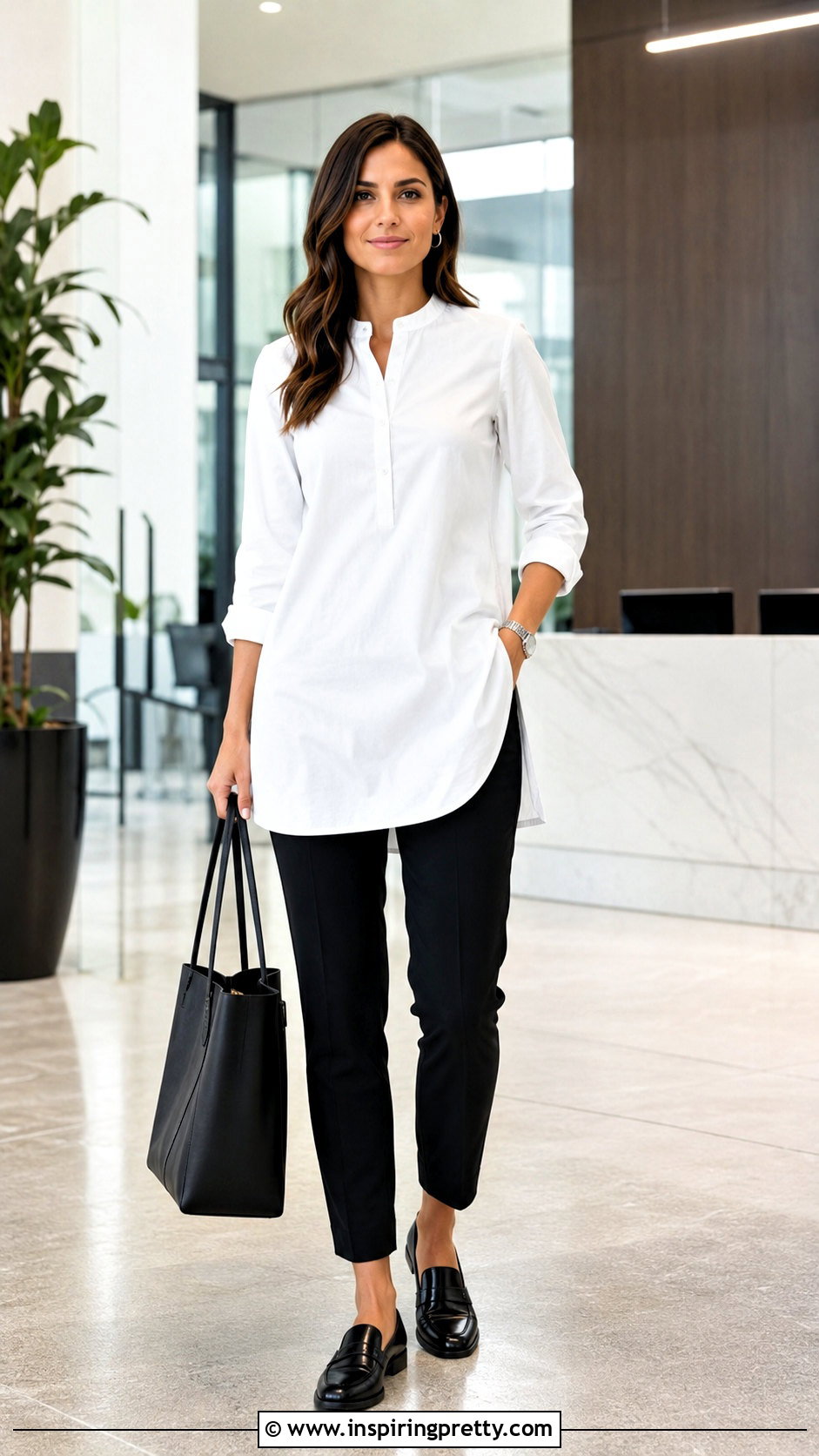
I start most people here because a white tunic over black ankle pants is the outfit you can wear on a day you've had no time to think. Go for cotton poplin with a proper collar and side slits; the slits matter more than they look, because they let the hem open over your hips instead of pulling across them when you walk. Slim or straight ankle pants keep the lower half clean. Loafers for comfort, pointed flats if you want it sharper. If the top feels too big, roll the sleeves twice and open the collar a button: putting definition near your face distracts from the volume lower down. It also sits well under a camel trench or a fitted cardigan.
2. Black Tunic Top With Gray Trousers
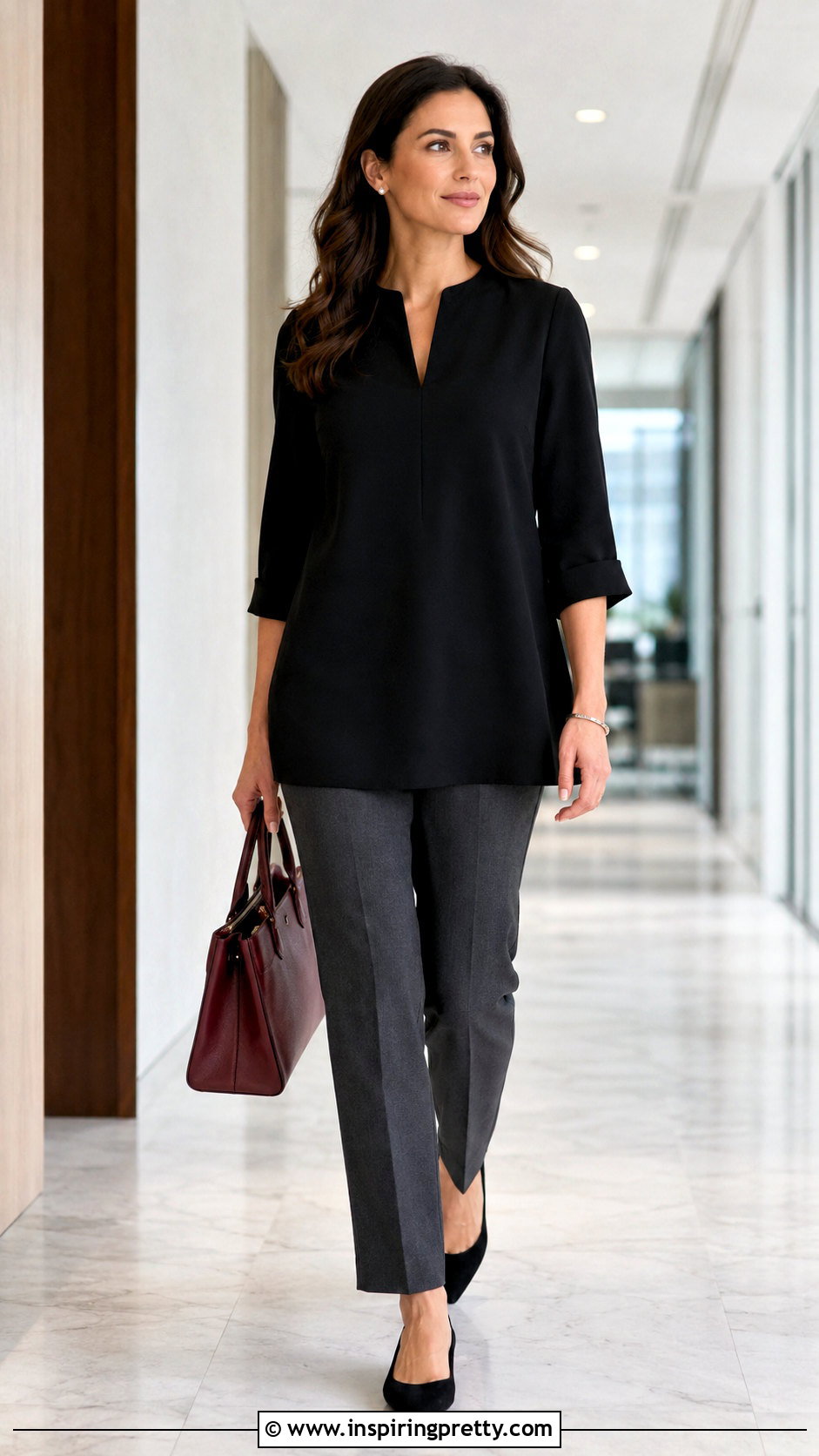
Black over gray is the combination I suggest for days with a presentation. It looks serious without being a suit. The tunic should be crepe, not T-shirt jersey, because crepe falls straight and doesn't catch on your hips. Charcoal cigarette pants keep the line narrow; medium-gray straight trousers move a little more. Black pointed flats tie back to the top, and a burgundy or forest-green bag is the one bit of color you need. If you add a blazer, make it a cropped one that stops well above the tunic hem. Before you leave the house, look at yourself side-on: a tunic that clings at the stomach or bunches at the back has the wrong drape for this look.
3. Navy Tunic Top With Beige Cigarette Pants
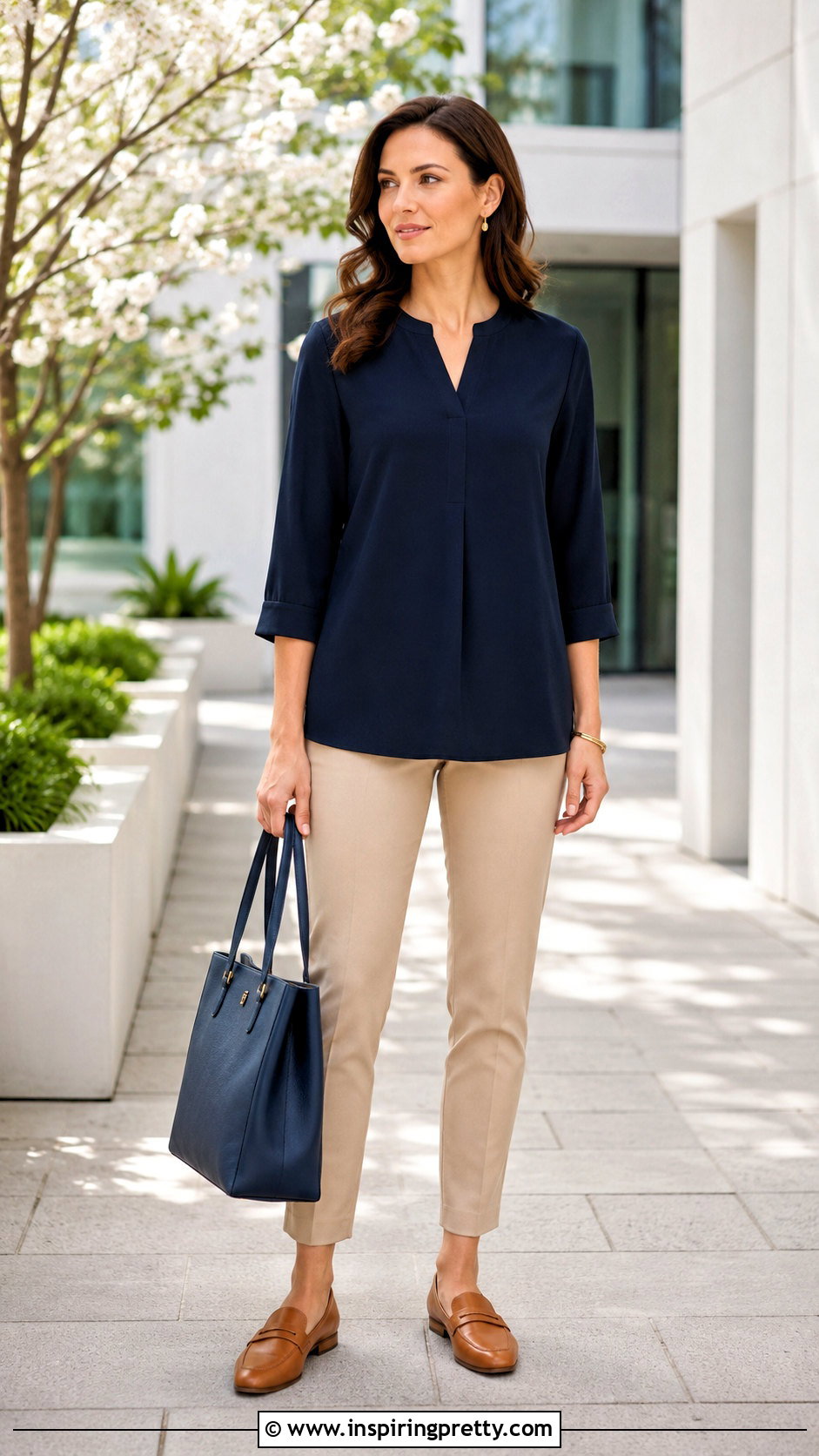
Navy on top and beige underneath flips the usual dark-bottom rule, and it makes the outfit feel lighter for spring. A modest V-neck and three-quarter sleeves keep it professional, and a gently curved hem looks less boxy than a straight one. Tan loafers, a tan belt bag worn at the shoulder and small gold earrings keep everything warm. One fit point I check here: pale cigarette pants show every pocket bag and waistband seam, so the tunic needs to cover the waistband fully. If you're petite, stop the hem at the upper thigh so your legs don't disappear. Taller frames can carry a longer split hem. An ivory cardigan, shorter than the tunic, handles a cold office.
4. Printed Tunic Top With Slim Black Pants
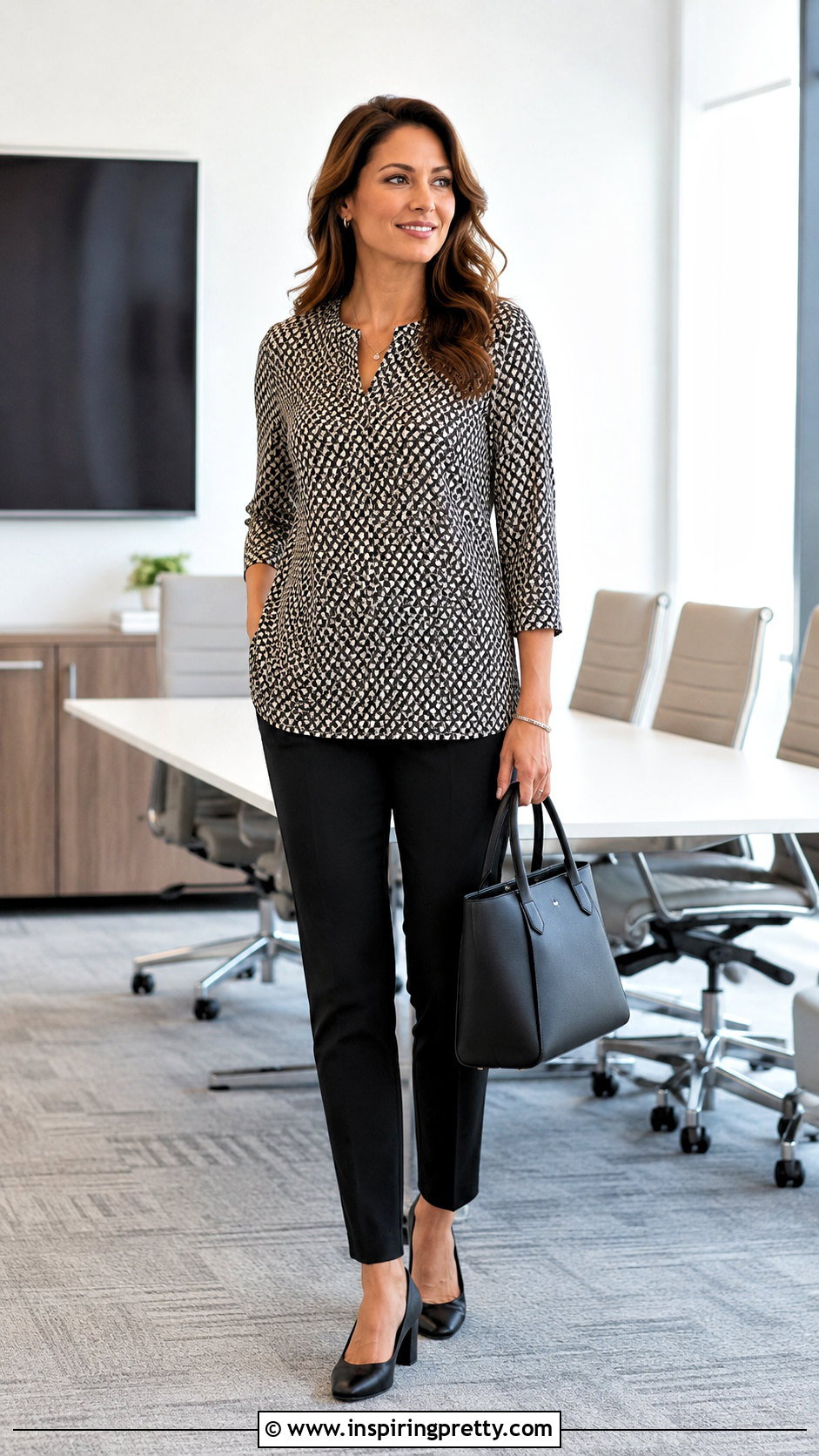
A print is the easiest way to keep a tunic interesting, as long as nothing else in the outfit competes with it. I look for a small geometric or abstract pattern that already contains black or navy, so the trousers have something to connect to. Pair it with slim black ponte pants that have real pockets and a flat waistband. Those details are what keep ponte from reading as leggings under a long top. Block-heel pumps or loafers depending on your office. Elbow-length sleeves or longer look more like workwear than a short sleeve does on a printed tunic. A fitted black blazer still lets the hem and cuffs show.
5. Button-Down Tunic Top With Navy Ankle Pants
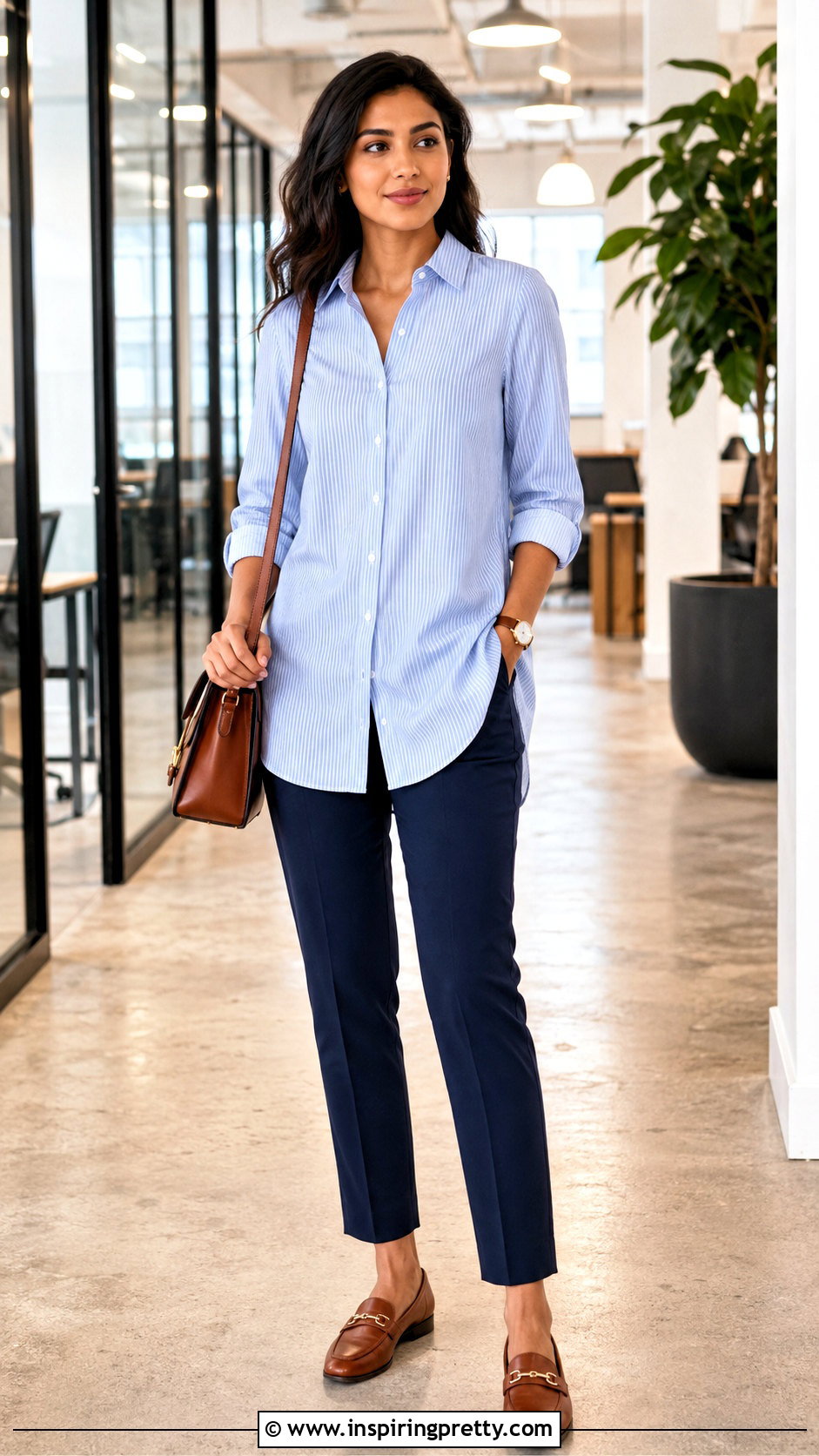
The button-down tunic is just a long shirt, which is why it reads as office-appropriate so quickly. Pale blue or a fine white stripe with navy ankle pants is the version I'd buy first. Watch the cut: a semi-fitted body and a curved shirttail hem look intentional, while a straight, boxy one looks like you borrowed it. Cognac loafers and a structured satchel suit the shirting. Leave the top button open in a relaxed office, and roll the sleeves just once or twice, since a shirt rolled to the elbow starts looking like weekend wear. If you need a layer, a waist-length knit jacket shows the long hem underneath instead of fighting it.
6. Belted Tunic Top With Straight-Leg Trousers
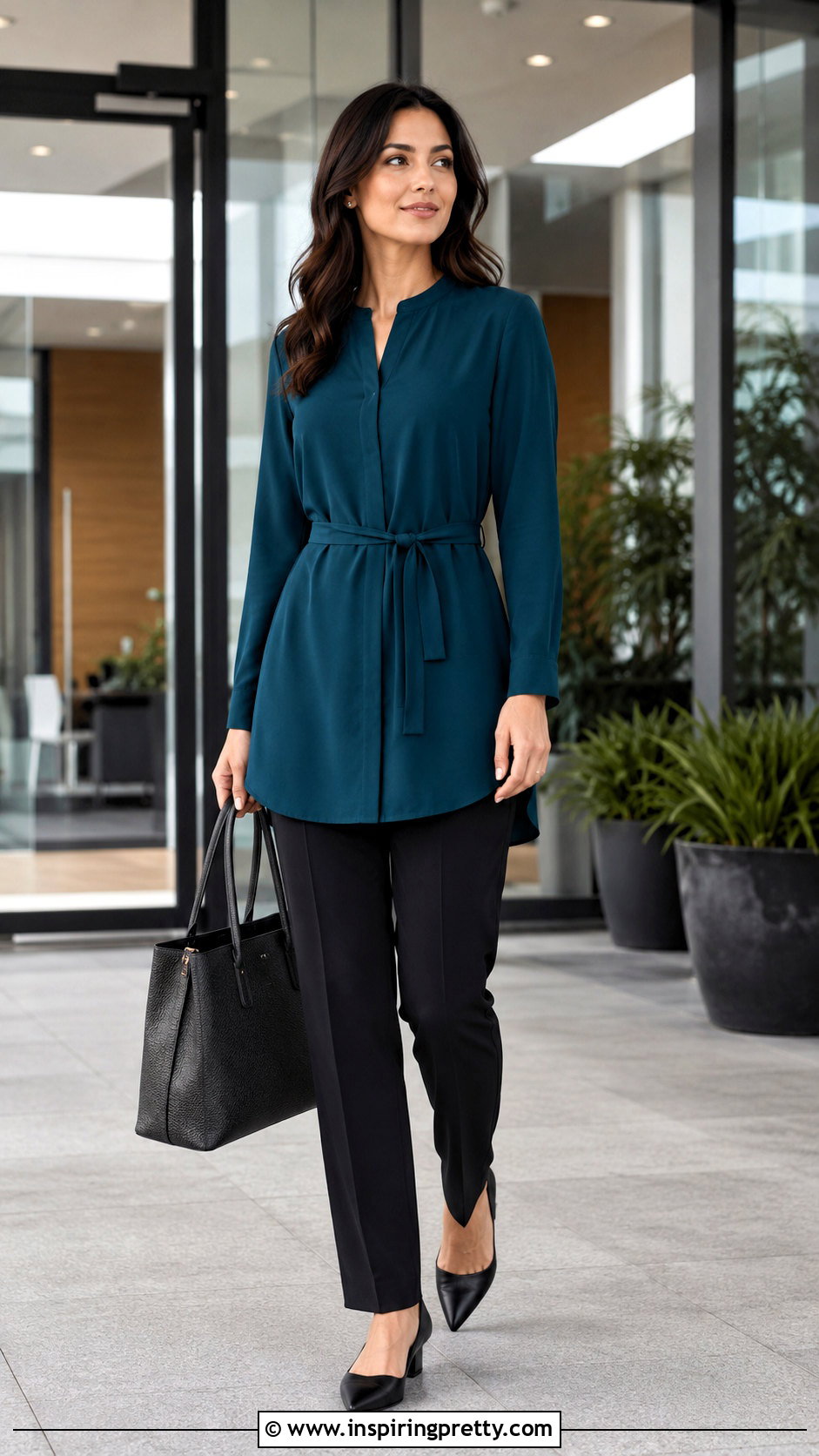
Belting is the fix for anyone who feels shapeless in a tunic. A softly belted tunic in a solid crepe, in burgundy, navy, olive or deep teal, sits well over straight black or charcoal trousers. Tie it at your natural waist, the narrowest point above your belly button, not low on the hips, and leave a little slack so the fabric blouses slightly over it. Pulled tight, a belt creates pulling lines across the back. I prefer a narrow self-tie belt in the tunic's own fabric for work; a wide contrast belt draws a hard line that's harder to wear. Pointed flats or low block heels lengthen the leg under the longer top.
7. Sweater Tunic Top With Ponte Pants
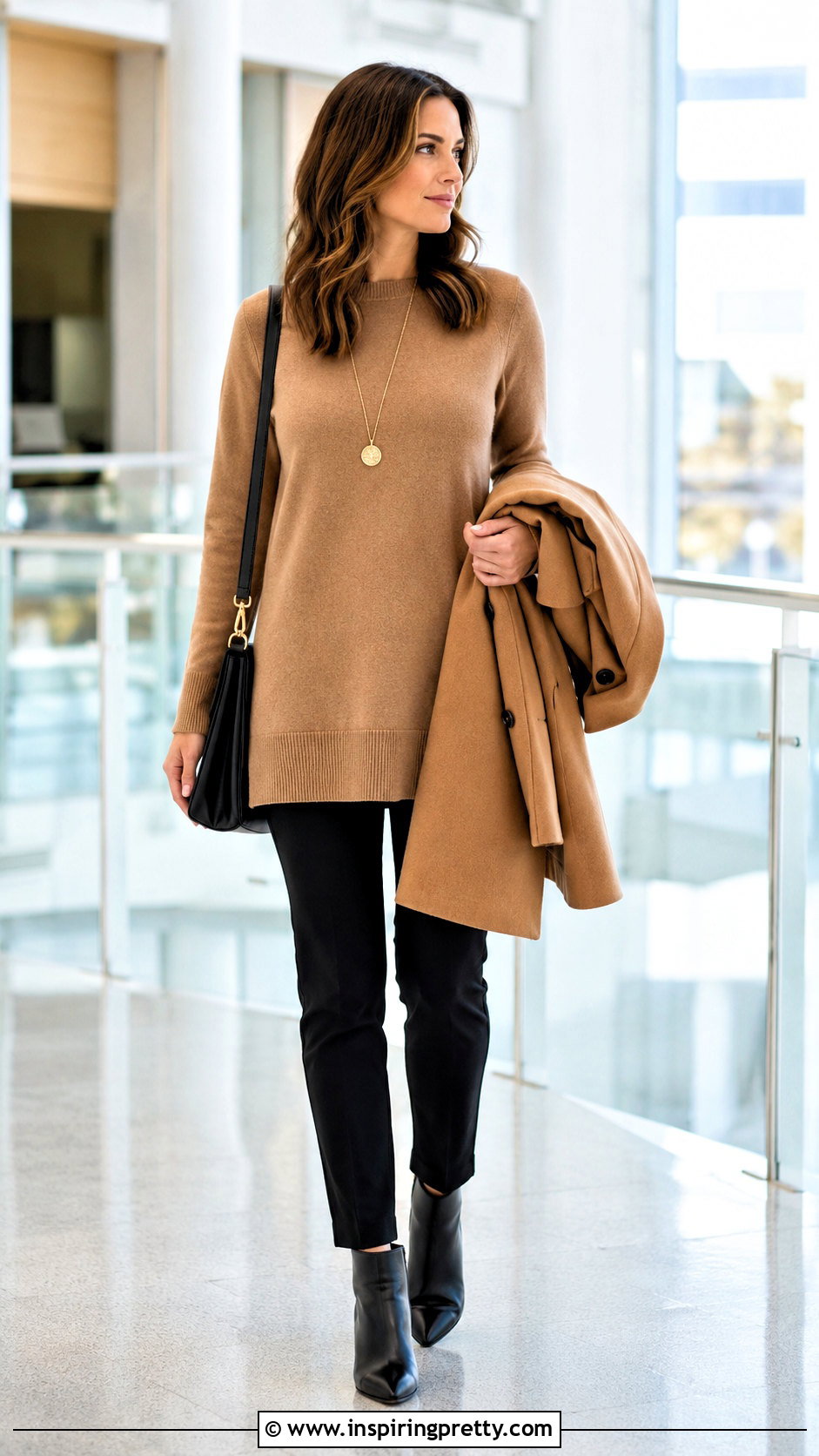
On cold mornings I'd reach for a sweater tunic with ponte pants, but only if both pieces have some weight. The tunic should be a smooth knit with side vents and a hem that stops before the knee. The ponte needs to be thick enough to fit like trousers, not like leggings; if you can see the outline of your pockets through it, it's too thin. Skip chunky cables in a formal office. A fine-gauge knit lies flatter under a coat and pills less at the underarms and where your bag strap rubs. Leather ankle boots and a long pendant give you one clean vertical line. Ribbed side panels add shape if the knit is loose.
8. Mock-Neck Tunic Top With Plaid Pants
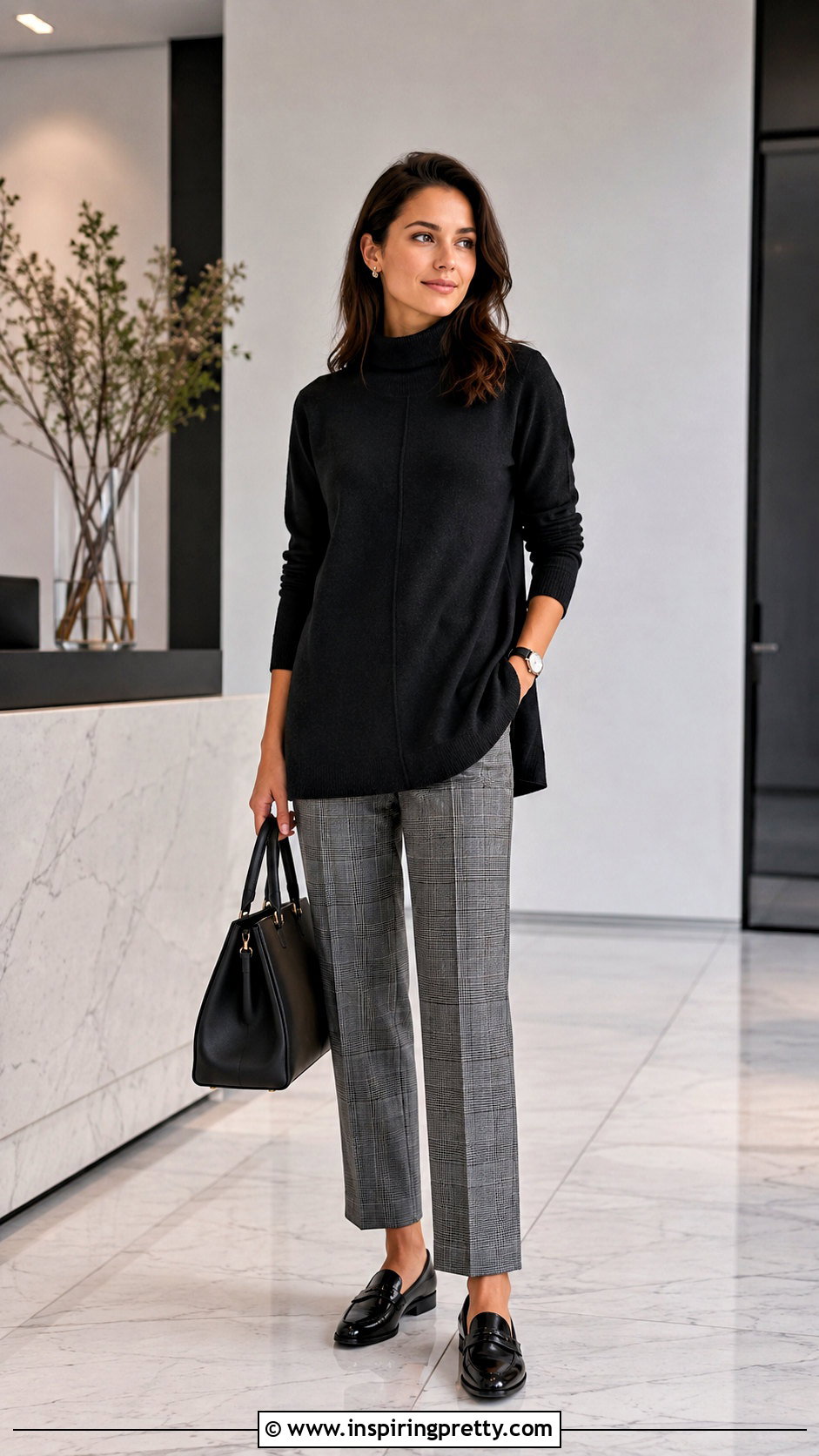
Plaid trousers are easier to wear to work than people expect, and a mock-neck tunic is the calmest thing to put over them. Keep the knit fine and the color pulled straight from the plaid, black, cream or dark green, so the two pieces look planned. A small check is more office-friendly than a large tartan. The mock neck already frames your face, so drop the necklace and wear small earrings. Black loafers or low ankle boots keep the bottom half sleek. The thing that goes wrong here is coat length: if your coat ends exactly where the tunic does, you get a heavy horizontal line. Go clearly longer or clearly shorter.
9. Satin Tunic Top With Tailored Black Pants
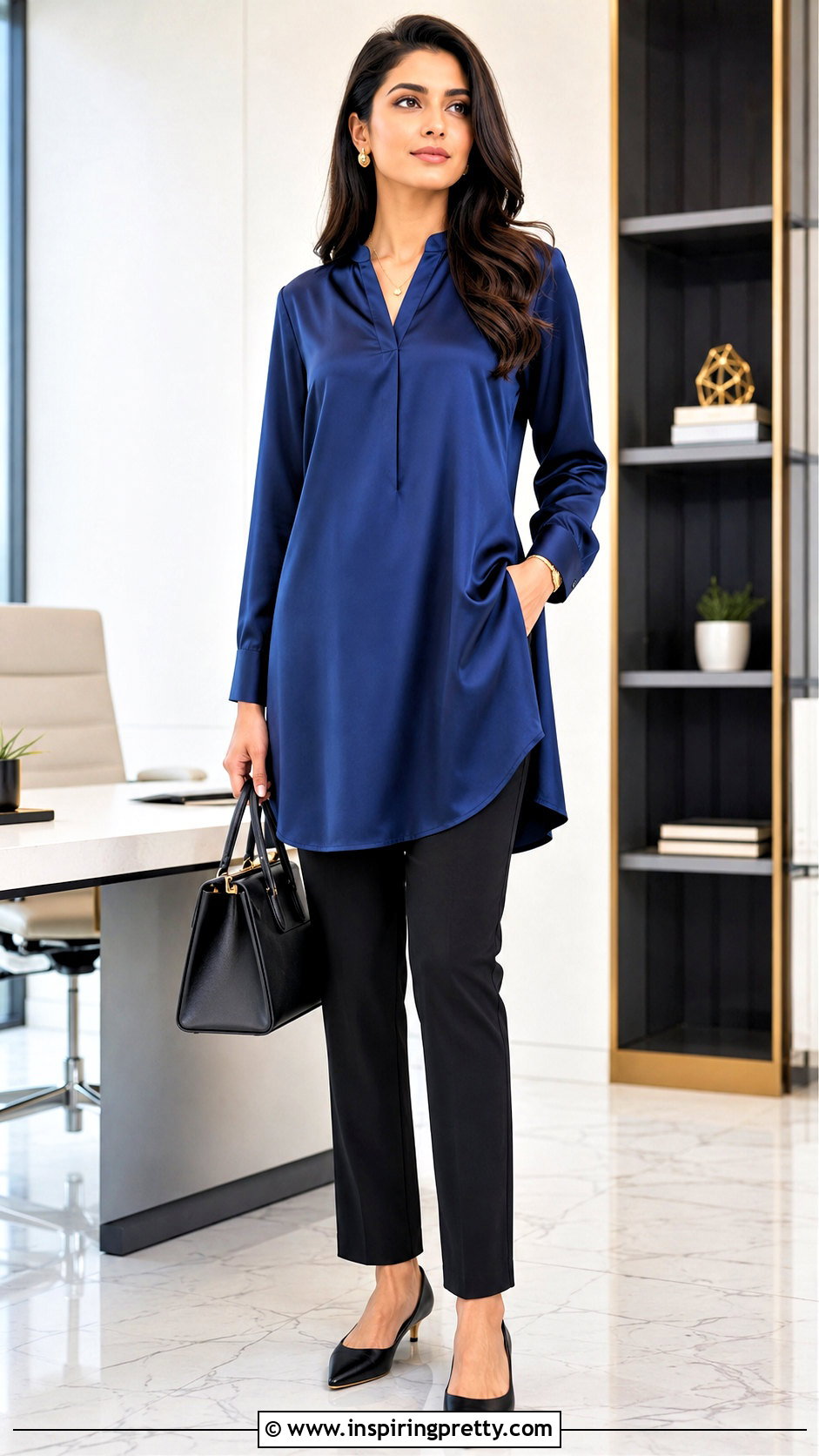
A satin tunic is dressier than most of this list, so I keep the sheen matte and the trousers plain black. Sapphire, plum or emerald look rich without shine. Satin has two honest problems at work. It shows creases from sitting and it shows every undergarment line, so steam it in the morning and wear a smooth camisole or a T-shirt bra underneath. It also marks under the arms on a warm day, which is worth knowing before a long meeting. Wear it untucked so the drape moves, with pointed flats and gold jewelry. A black collarless jacket is the layer I'd add, provided the tunic hem doesn't hang far below it.
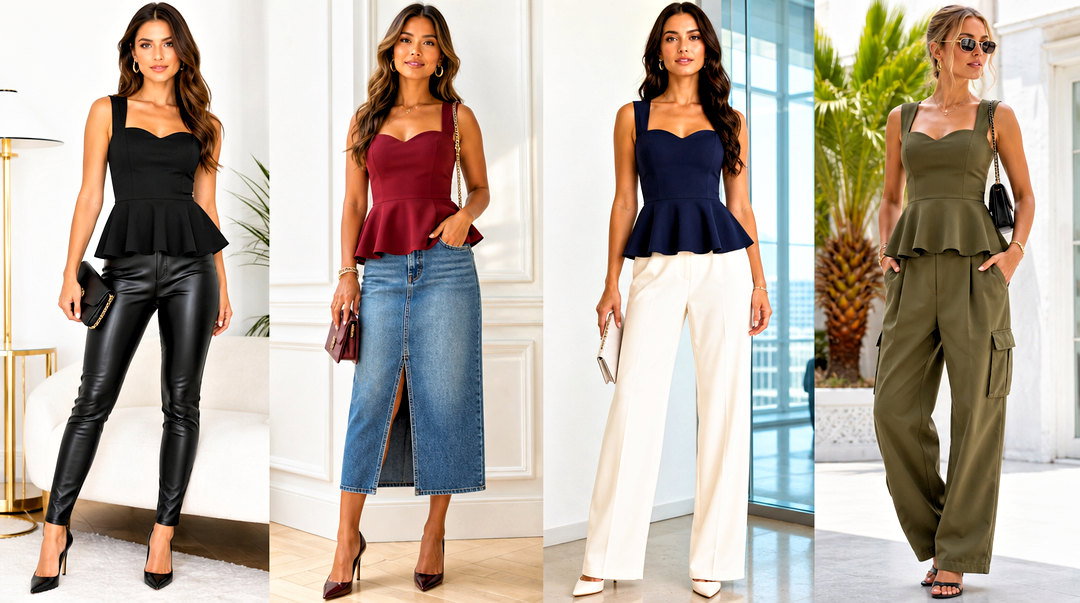
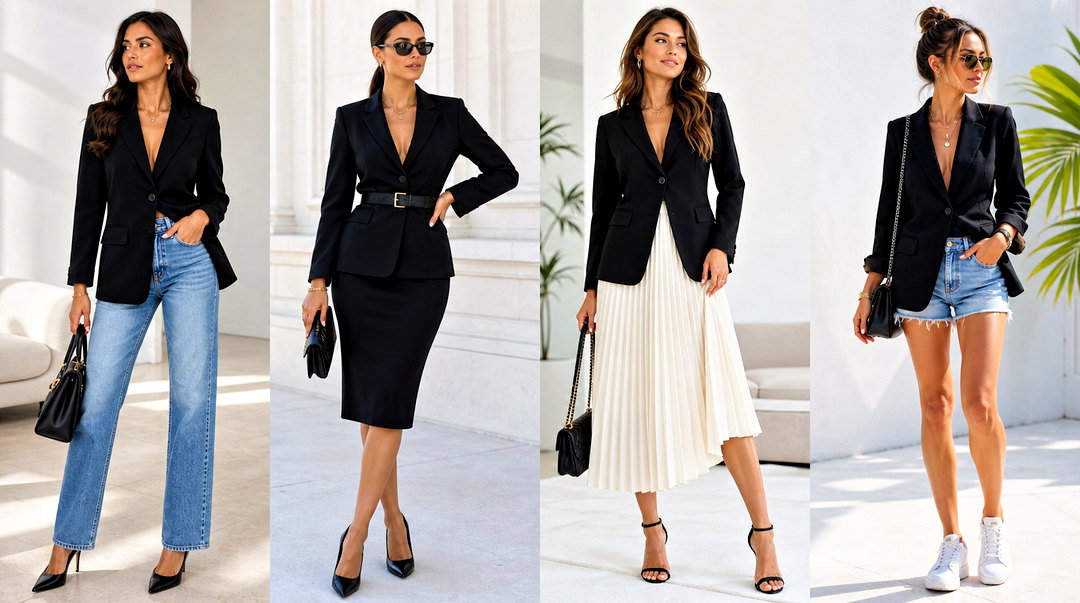
10. Linen Blend Tunic Top With Cropped Trousers
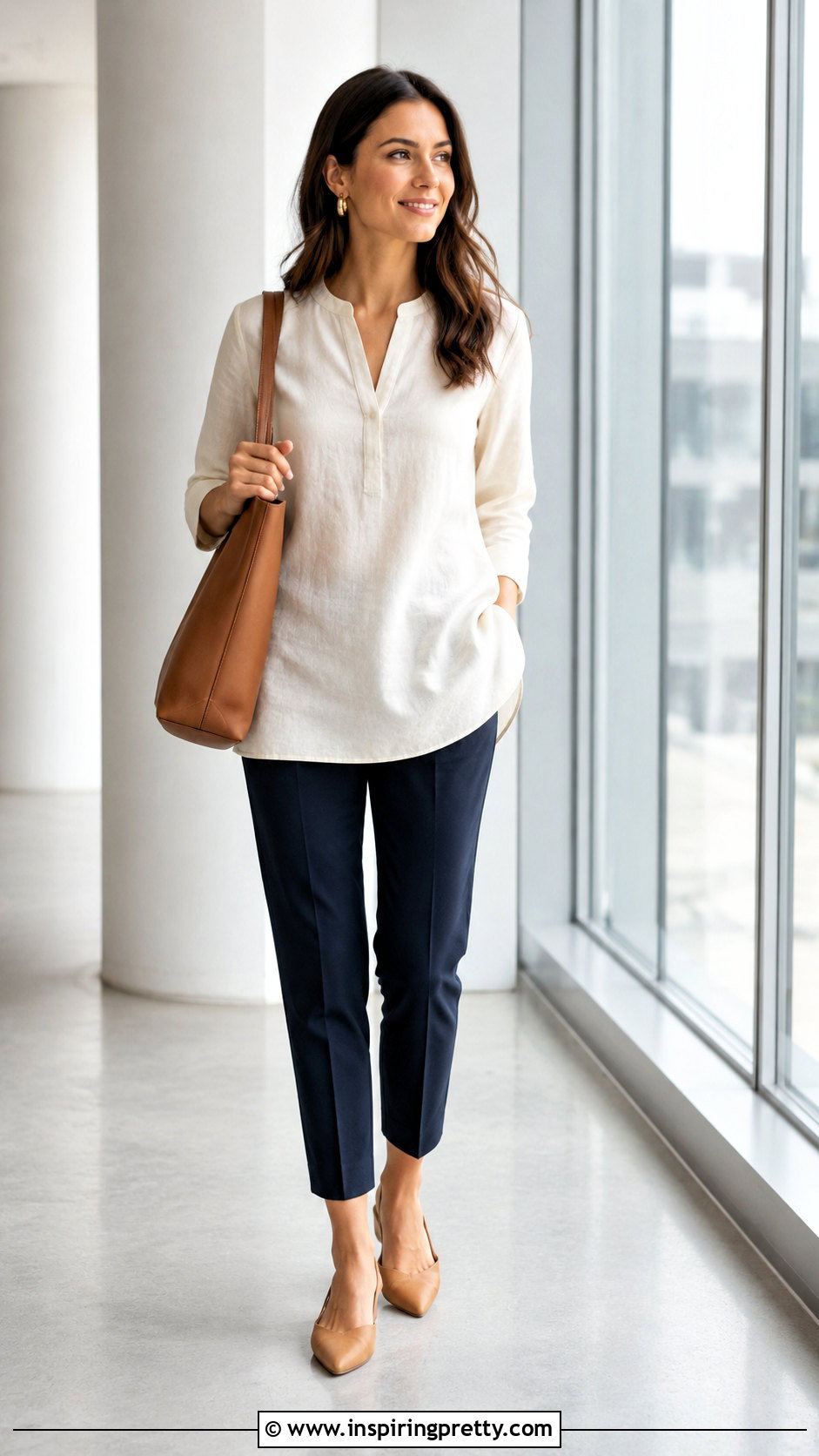
In hot weather I'd pick a linen blend over pure linen for the office. Pure linen breathes well but creases deeply by mid-morning, and a blend with cotton or viscose holds its shape far longer. Look for a collar or a covered placket so it stays looking like workwear. Pair it with tapered trousers that end just above the ankle, in navy, stone or soft gray, and leather slingback flats or loafers. Hold it up to a window before you buy: pale linen in ivory or sage is often more sheer than it looks in a shop. A nude-to-you camisole fixes that without adding bulk.
11. Striped Tunic Top With Navy Trousers
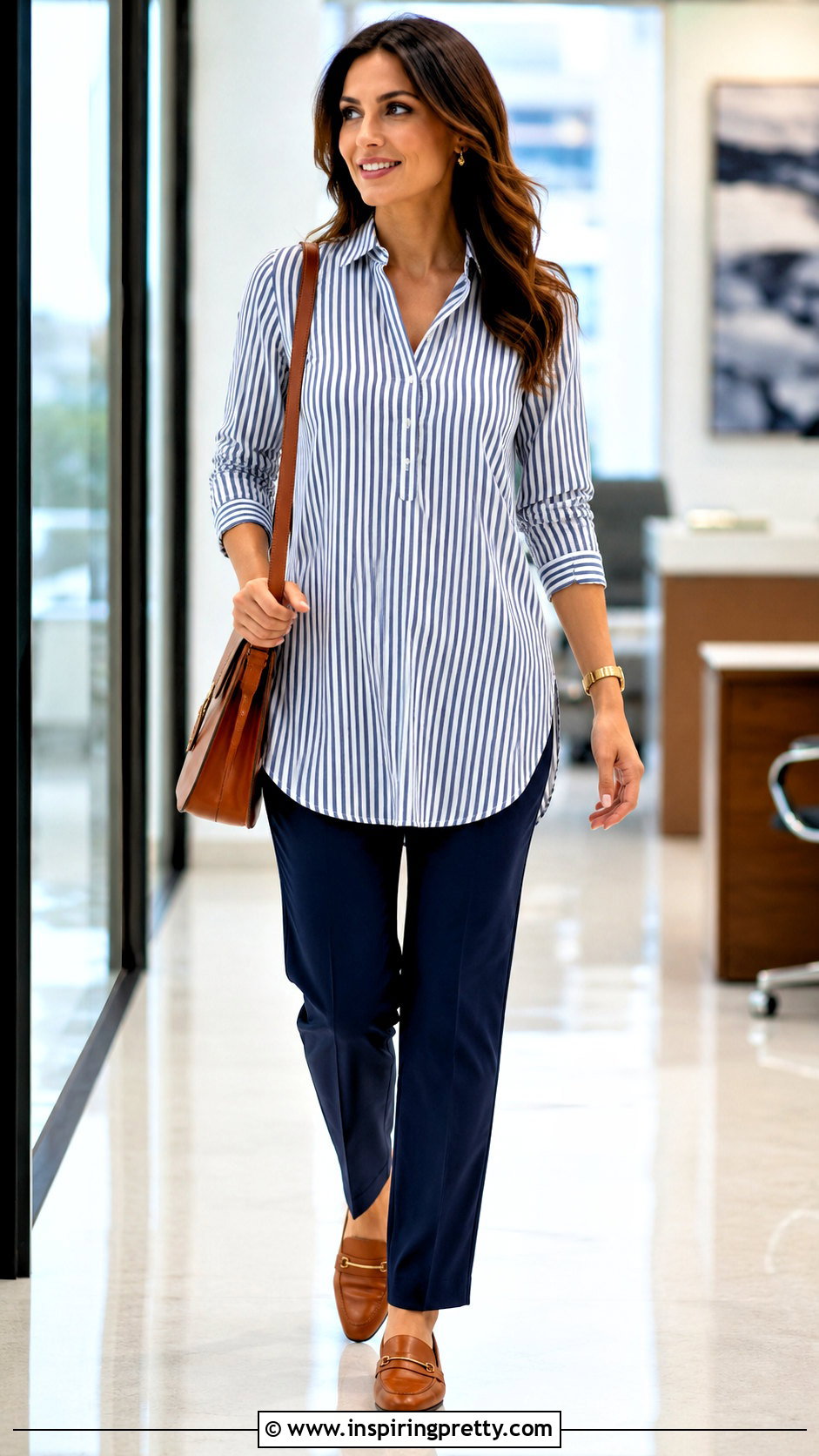
Stripes are where I see the most mistakes in office tunics, usually because the stripe is too wide. Narrow vertical stripes in blue and white keep the long shape looking slim; wide stripes stretch it sideways. Navy straight-leg trousers underneath work in every season. Tan loafers, a cognac satchel and a slim gold watch warm it up. Check the side slits while sitting down: if they open above your waistband, everyone sees the top of your trousers and any shirt you're wearing underneath. A short navy cardigan over the shoulders covers the air conditioning. It's a good middle ground for a conservative office that has relaxed its dress code.
12. Color-Block Tunic Top With Neutral Pants
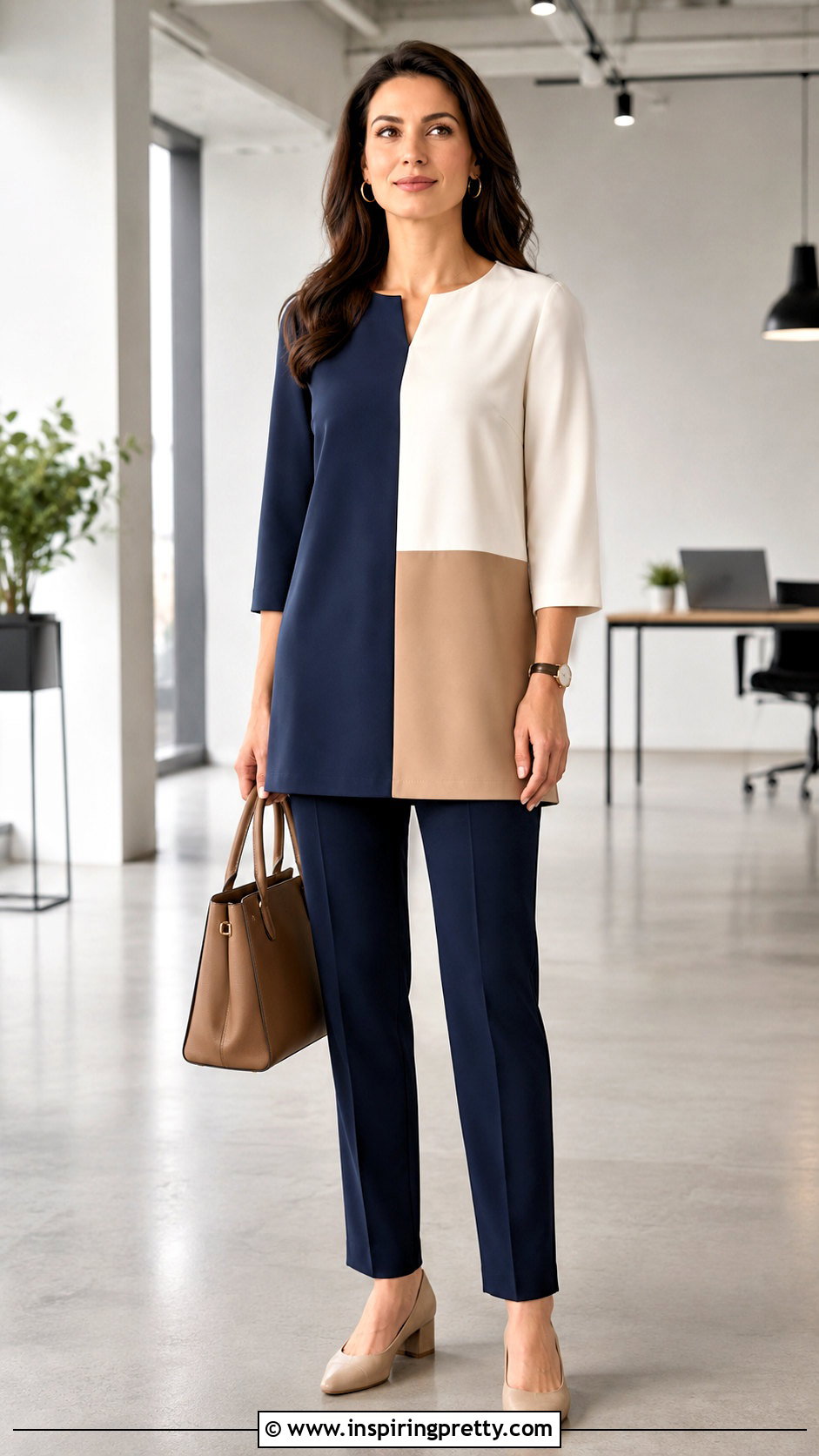
A color-block tunic does the work of a print with cleaner lines, which suits offices where florals feel too casual. Keep it to two or three colors from the office palette, navy, ivory, camel or burgundy. Match your trousers to the darkest panel and the outfit reads as one long base with color on top. The placement of the panels matters more than the colors. Darker panels running down the sides pull the eye inward and act like a slimming seam, while a light panel across the stomach does the opposite. Skip sporty details like contrast zips. A plain structured bag and loafers or low block heels keep everything else quiet.
13. Olive Tunic Top With Cream Trousers
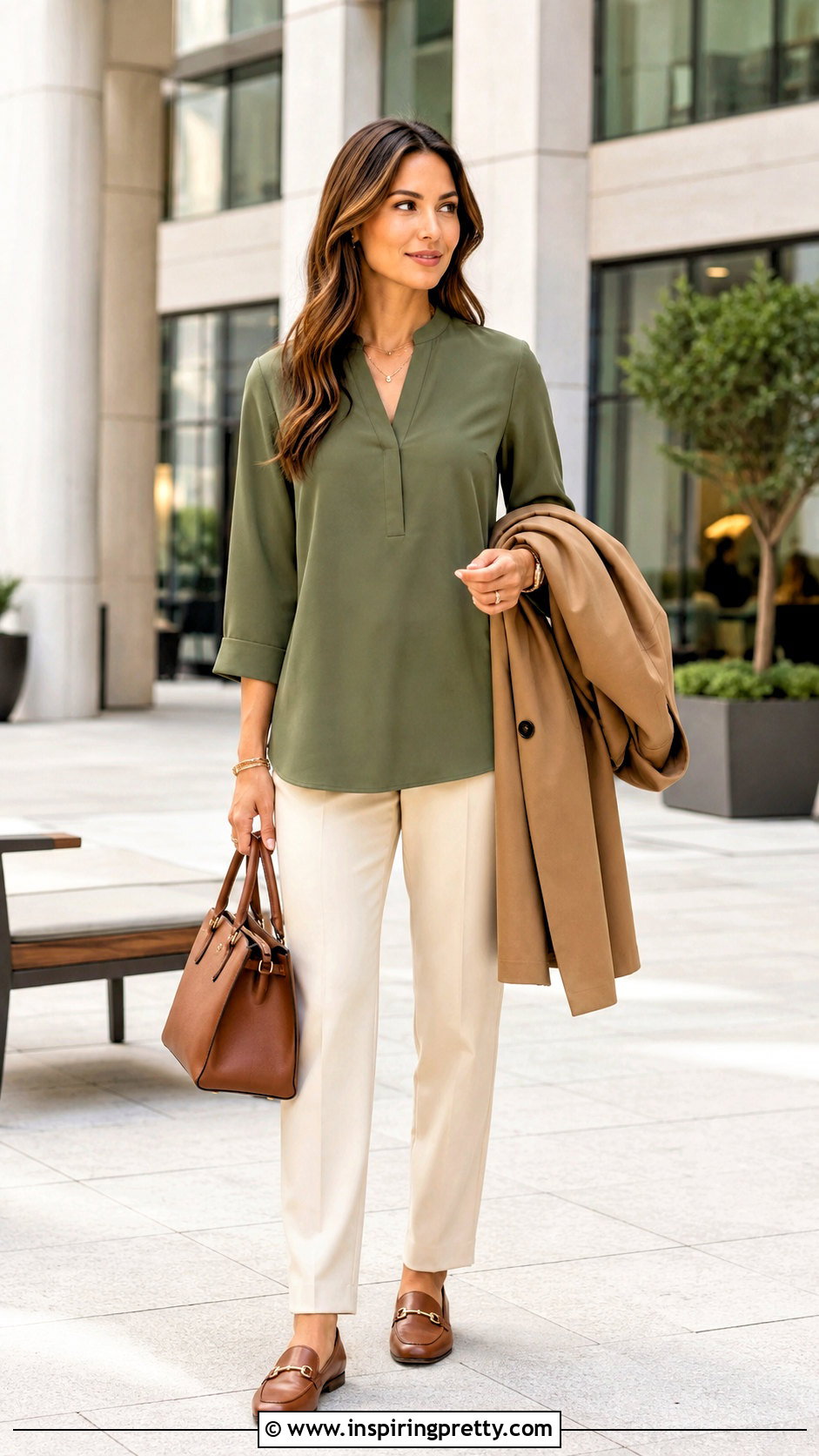
Olive and cream is the pairing I bring out in early autumn, when black feels too heavy. An olive tunic with elbow or three-quarter sleeves, over straight or gently tapered cream trousers, looks fresh and still neutral. The trousers need to be opaque and substantial; thin cream fabric shows the pocket lining and the waistband. That also means any tie, button or bulky closure at the waist will print through the tunic, so I choose a flat-front pair. Cognac loafers, a matching bag and gold jewelry pick up the warmth in the green. A camel blazer or trench is the outerwear that fits the palette without adding a new color.
14. Blazer With Tunic Top And Ankle Pants
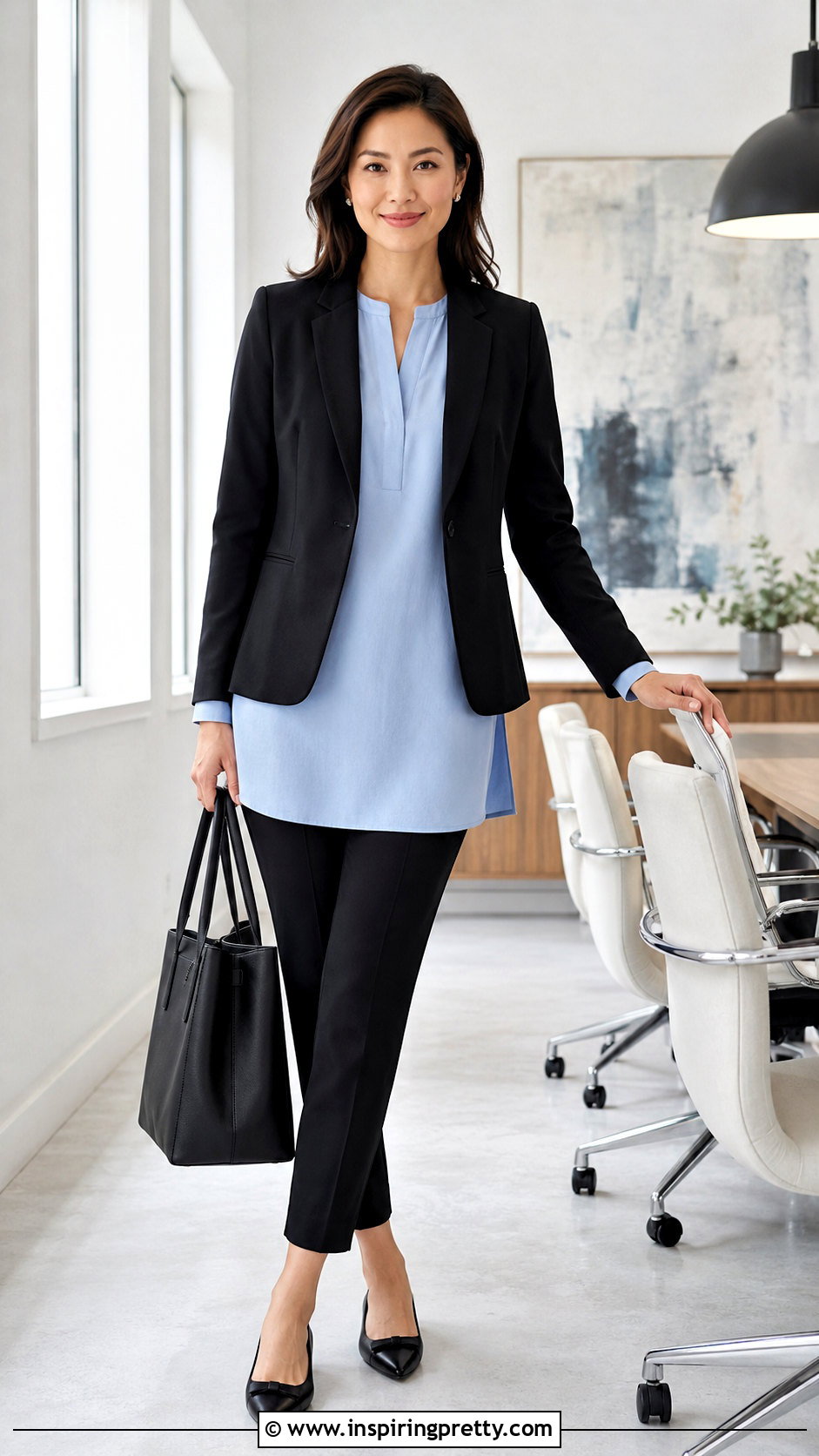
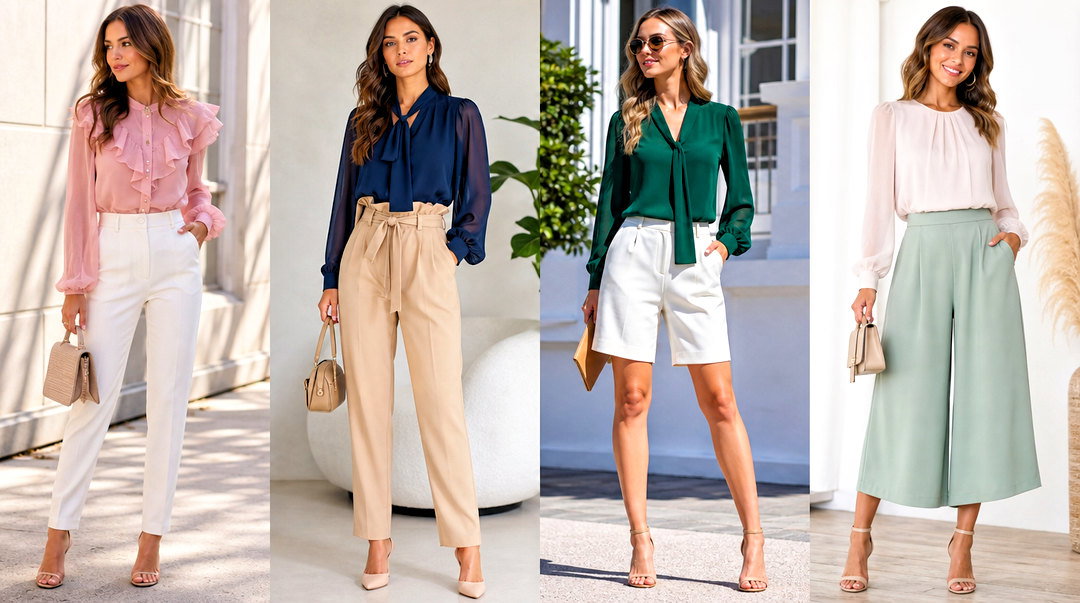
A blazer turns a soft tunic into something you could wear to meet a client. The tunic underneath should be sleeveless or short-sleeved, because two sets of long sleeves bunch at the elbow and pull the jacket out of shape. Ivory, blush or soft blue is easy under a darker jacket. Pick a blazer that ends around the high hip so it sits clearly shorter than the tunic. Try it buttoned in the fitting room even if you'll wear it open; if it strains across the bust over the tunic, it will pull open at an angle all day. Gathered sleeves and ruffles fight a jacket, so a flat, plain tunic is the better choice here.
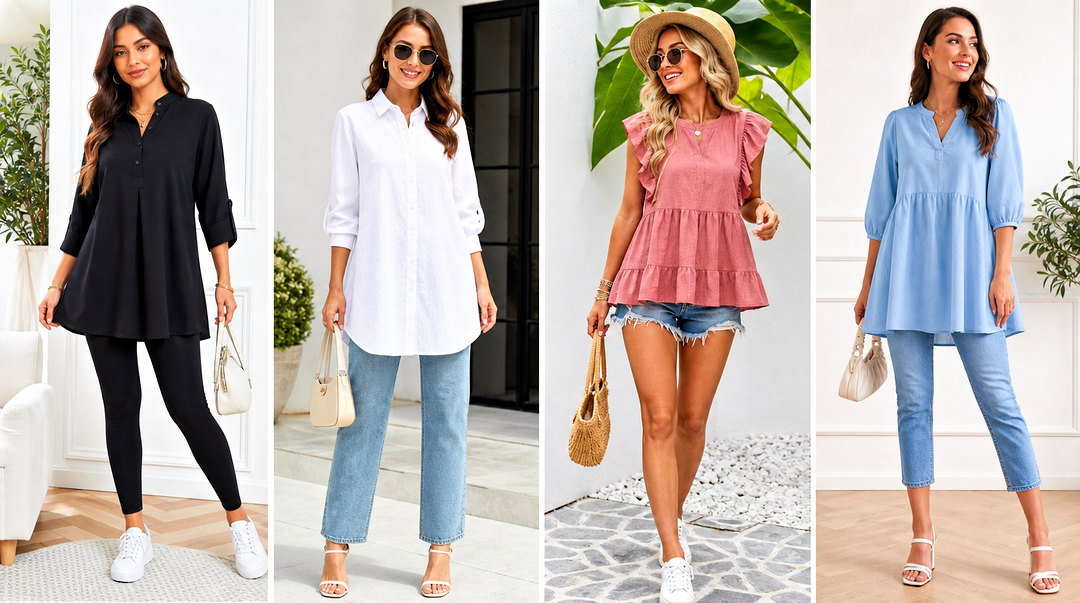
15. Cardigan With Tunic Top And Slim Trousers
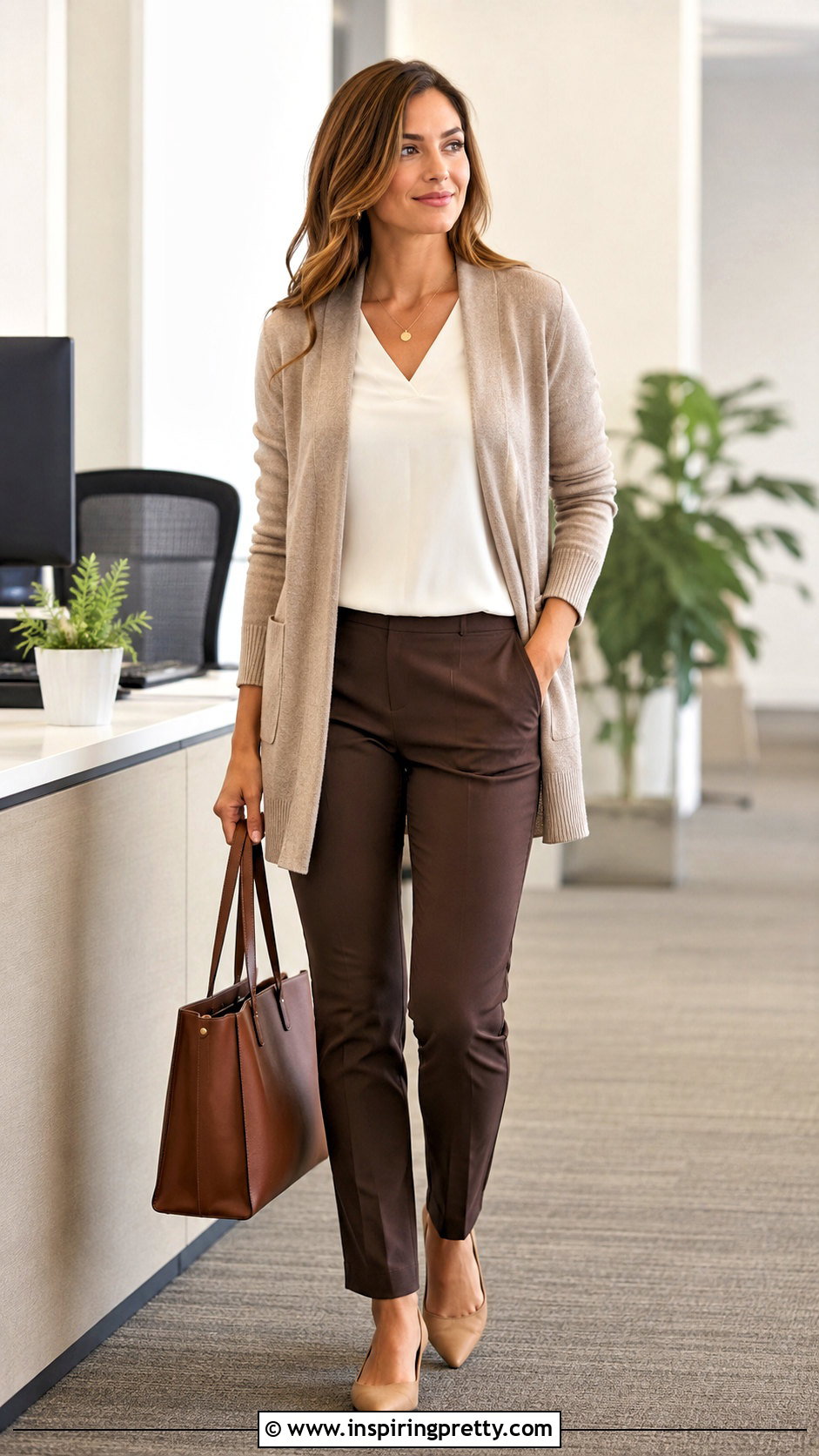
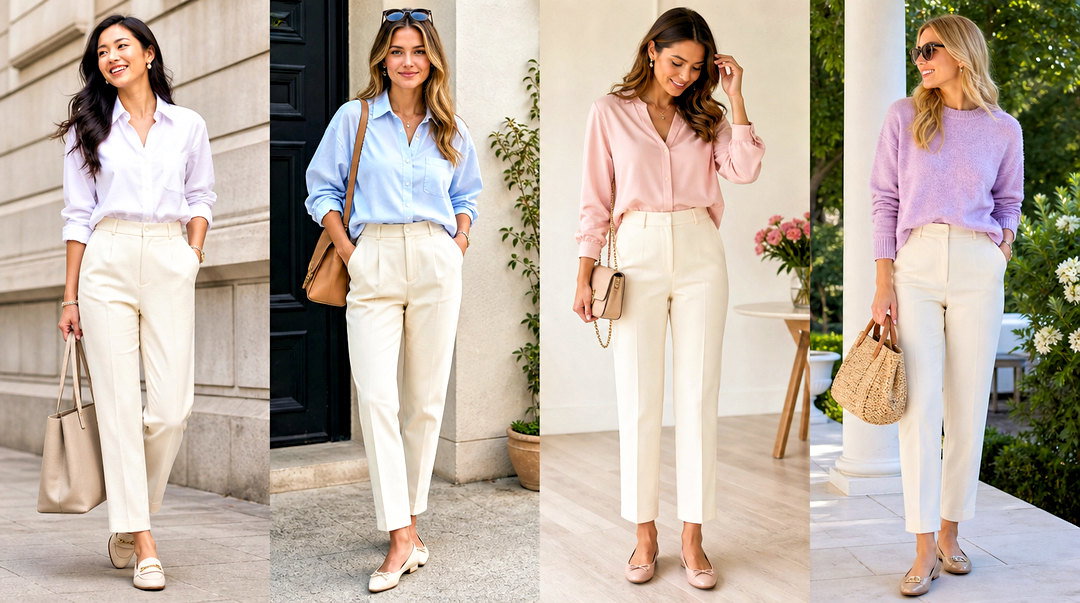
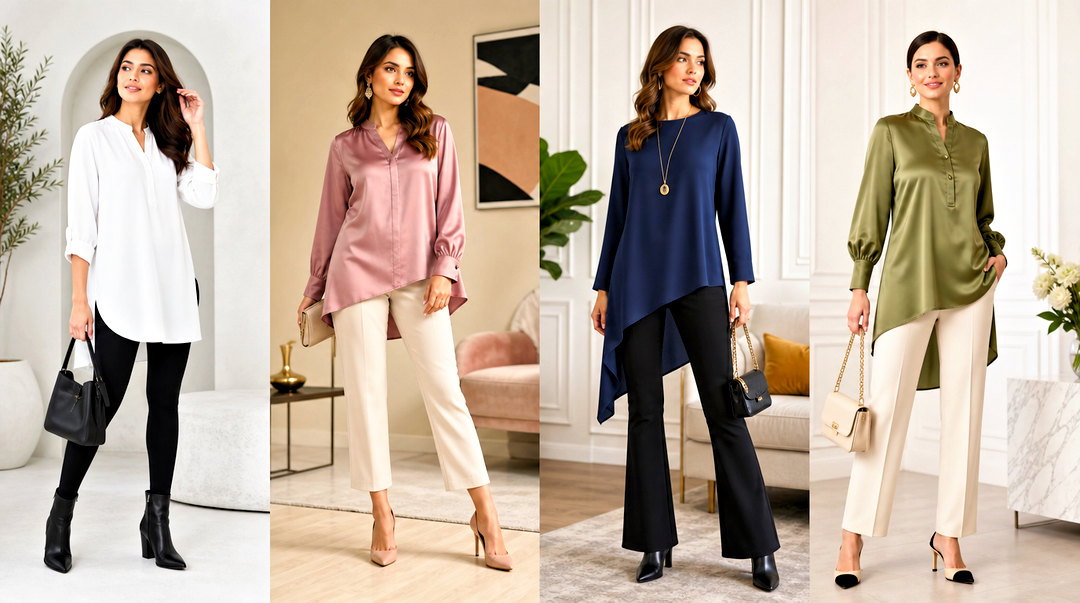
Cardigan, tunic and slim trousers is my quiet office uniform for air-conditioned buildings. A tonal top layer, an ivory tunic under a beige cardigan, looks considered with very little effort. Ground it with navy, charcoal or chocolate trousers and loafers or almond-toe flats. The cardigan length is the decision that makes or breaks it. It should end clearly above the tunic hem or fall well past it; two hems a few centimetres apart look like a mistake and add bulk at the hips. Wear it open. The two front edges give you two long vertical lines down the body, which slims the whole outfit.
16. Asymmetrical Tunic Top With Cigarette Pants
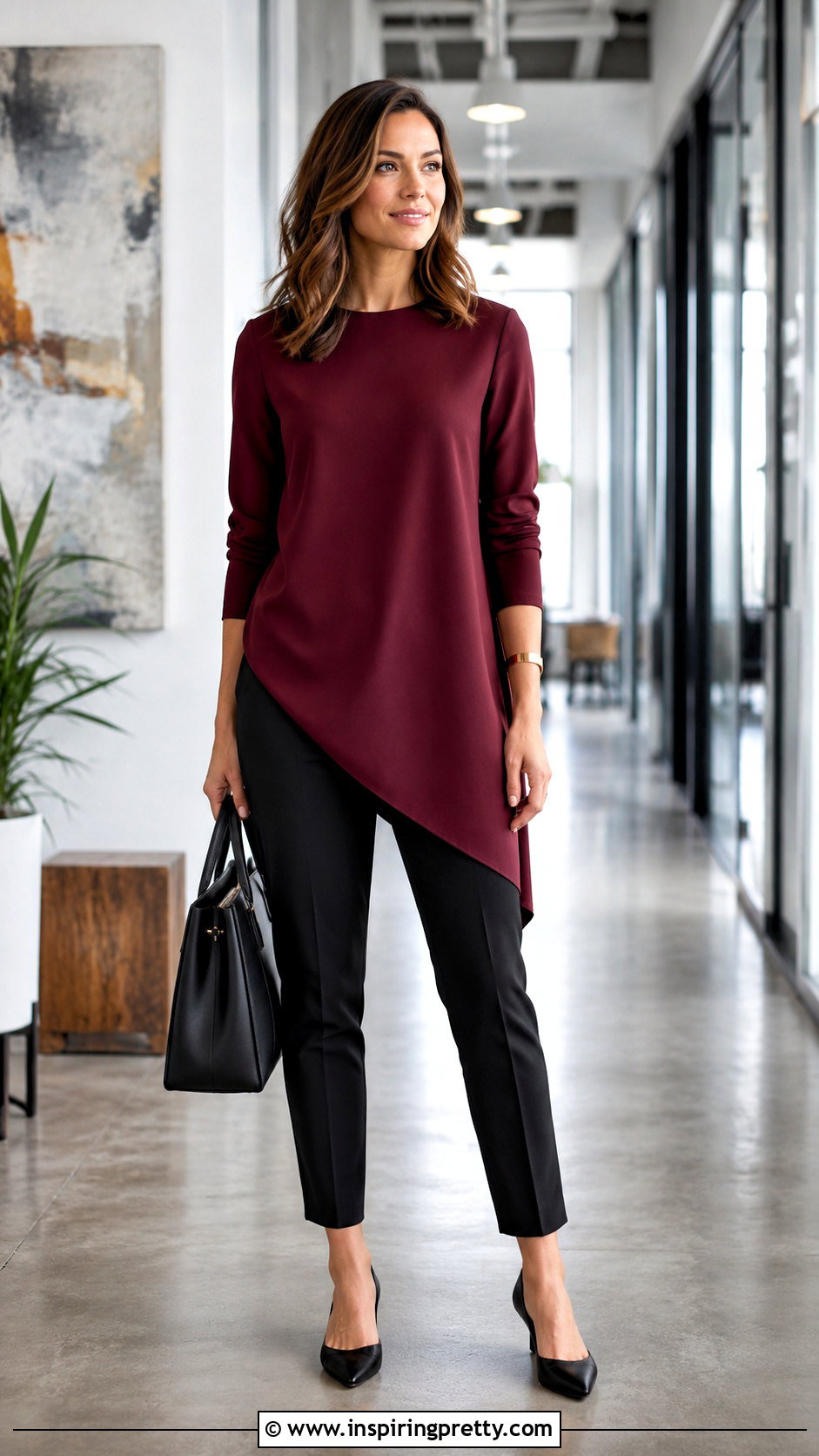
An asymmetrical tunic brings a bit of design into a plain office outfit, but the hem needs restraint. A gentle diagonal or a stepped hem reads modern; dramatic points and handkerchief hems read as evening wear. Keep the tunic in one solid color, since the cut is already the interesting part, and put it over narrow black, navy or charcoal cigarette pants. Leave the neckline bare and wear one simple cuff. The practical check is sitting down: the shortest point of the hem should still cover your seat and waistband in a chair. This shape suits creative offices and conference days better than a very traditional workplace.
17. Pleated Tunic Top With Straight Black Pants
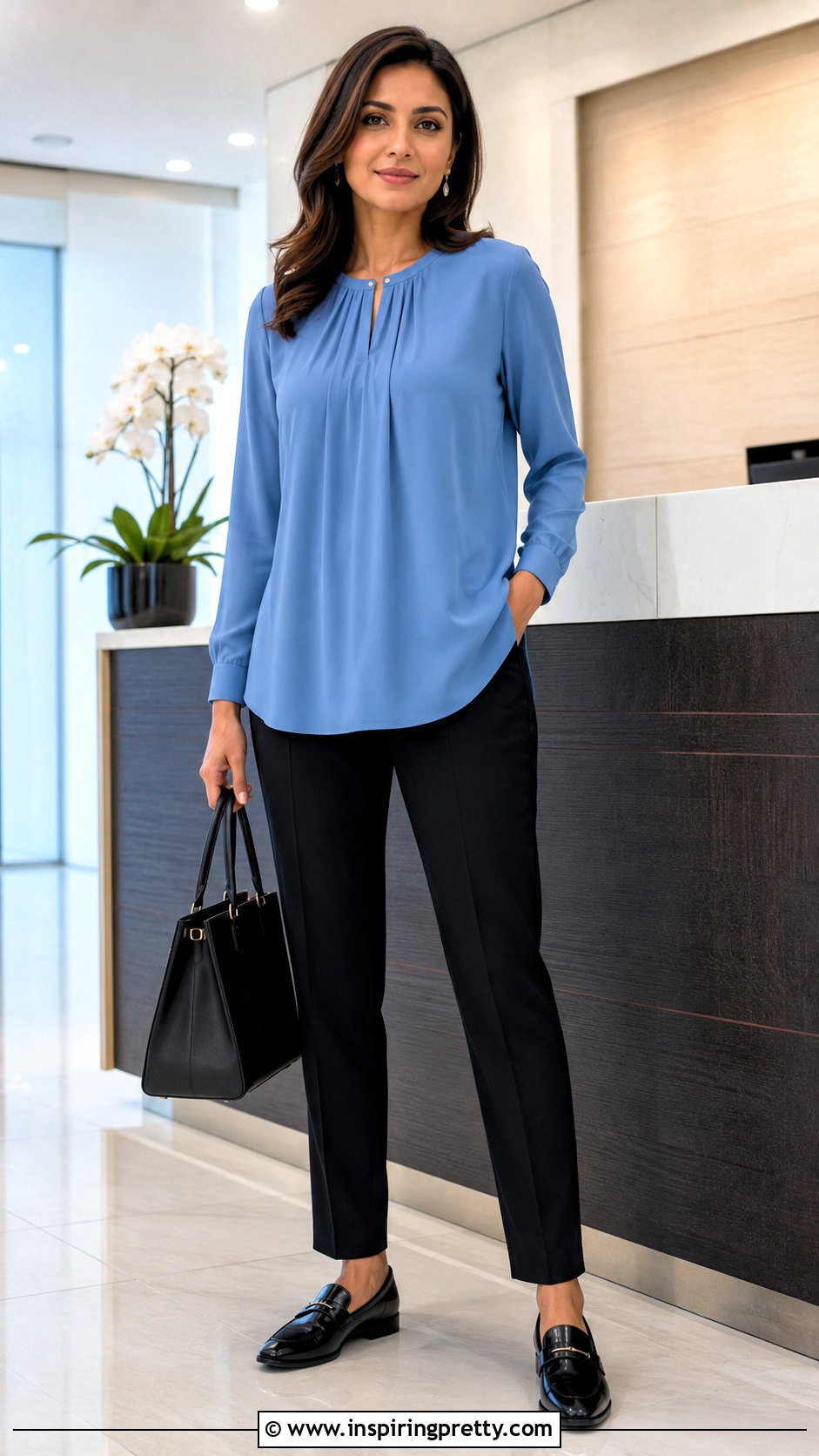
Pleats give a tunic movement, and they also add volume exactly where they sit, so placement matters. Pleating at the neckline or back yoke is easy to wear; heavy pleating across the full front adds width at the bust. Over straight black trousers, a pleated top in dusty blue, mauve or forest green looks soft but still professional. I'd avoid combining pleats with big sleeves, since the two together can double the width of your upper body. If the neckline is high, wear your hair up so the top area stays open. A fitted blazer is fine over the top, but leave it open so it doesn't press the front pleats flat.
18. Turtleneck Tunic Top With Cropped Dress Pants
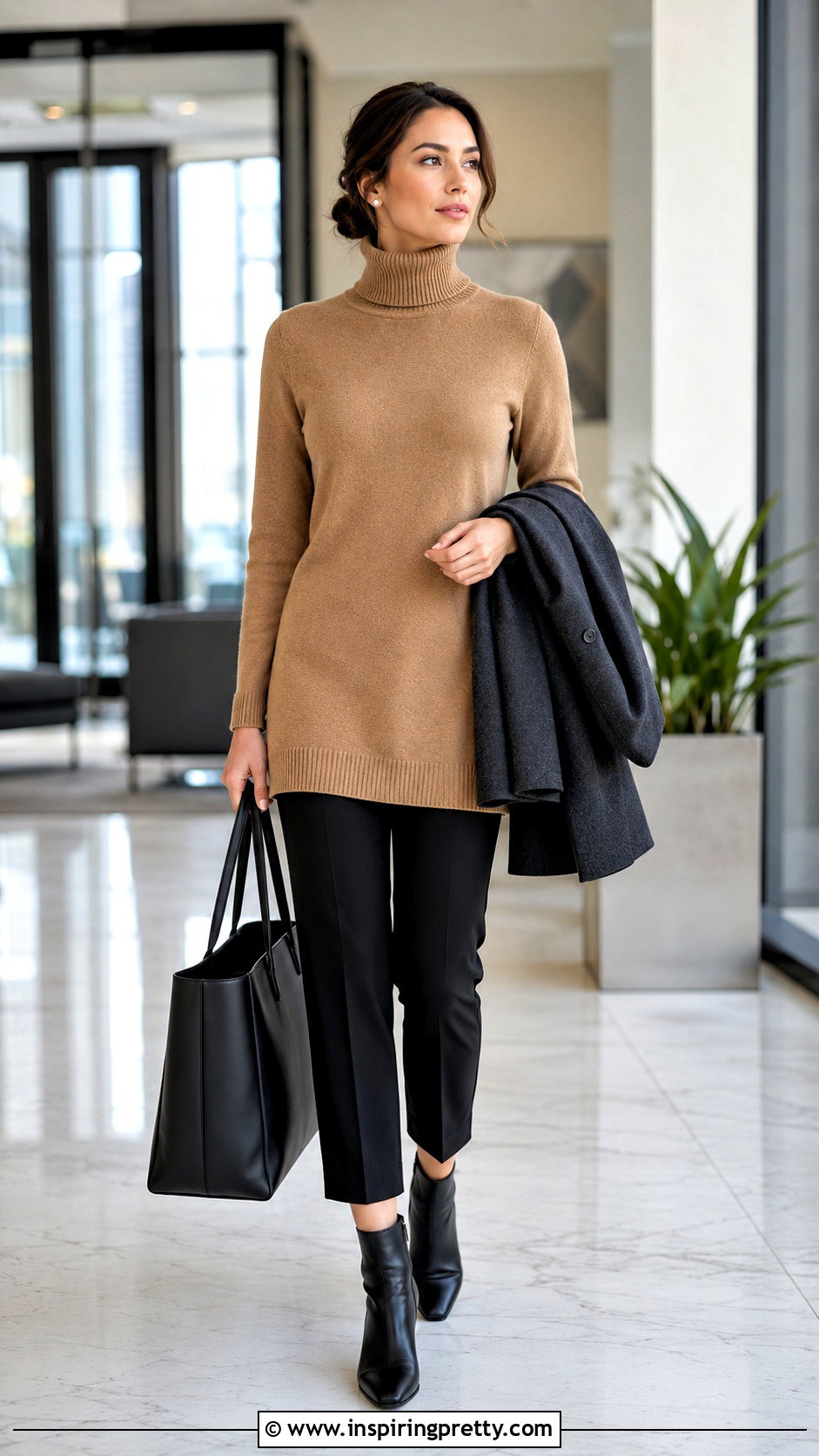
A turtleneck tunic with cropped dress pants keeps you warm in one layer instead of three. Fine-gauge knit is the only version I'd suggest for work. A thick roll neck adds bulk under the chin and makes a coat collar sit badly. Camel, charcoal, navy or burgundy are all easy. The cropped black trousers show a small strip of ankle, and that gap is what stops a long knit top from feeling heavy. Ankle boots should have a narrow shaft that slips under the trouser hem without pushing it out. A tunic with side vents or a slight taper gives a little shape without a belt.
19. Monochrome Tunic Top With Matching Trousers
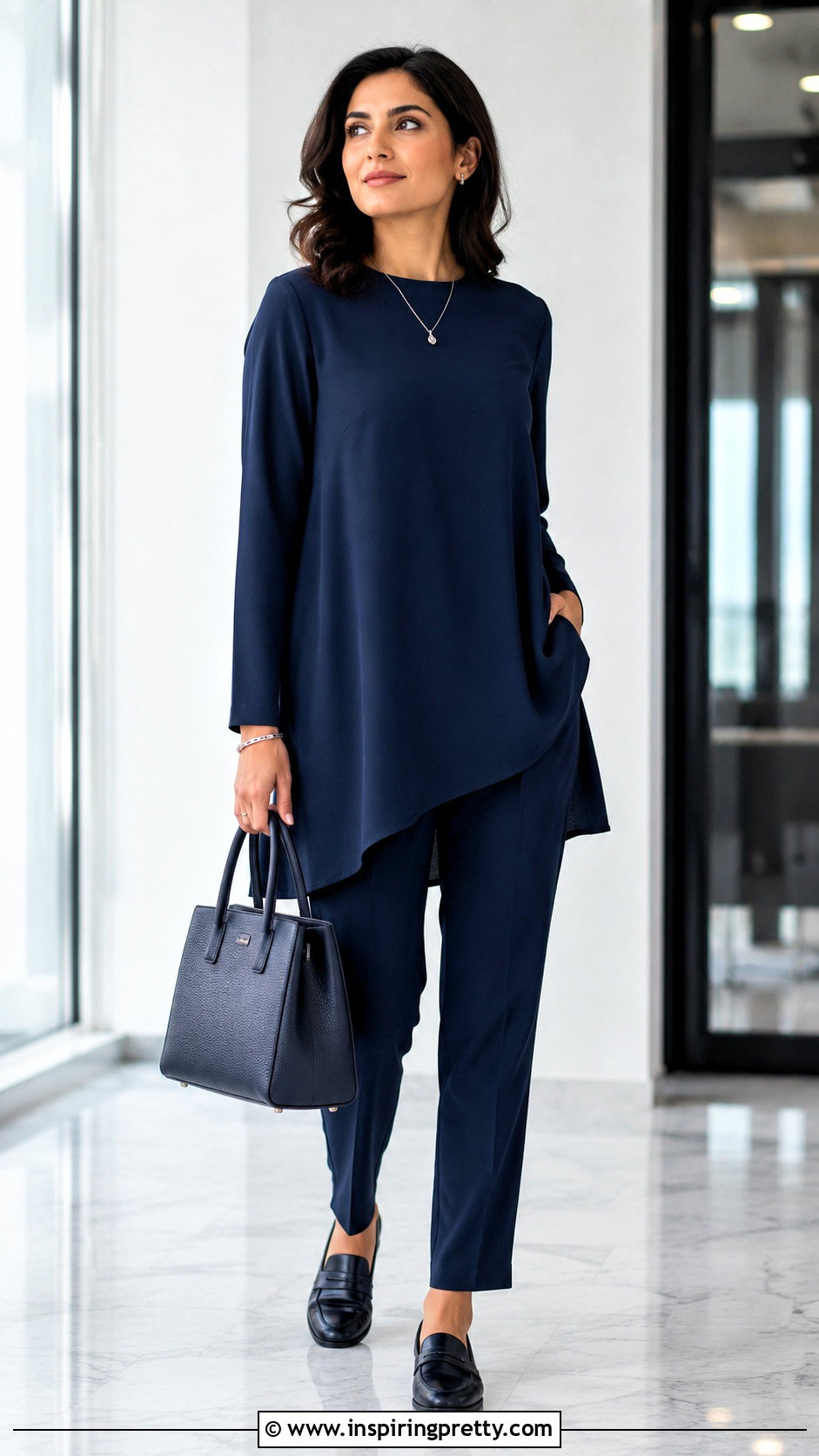
Monochrome is the fastest outfit on this list to put together, and it makes you look taller. Choose a tunic and trousers in related shades of navy, charcoal, chocolate or soft beige. They don't need to match exactly, but the undertones do: a warm brown next to a cool gray-brown looks like two outfits. Keep the shoes in the same color family so the line runs to the floor. Contrast should come from texture, a smooth crepe tunic against a lightly woven trouser and a leather bag, rather than from color. A thin metallic piece of jewelry is enough. When I get dressed in a hurry, this is the one I default to.
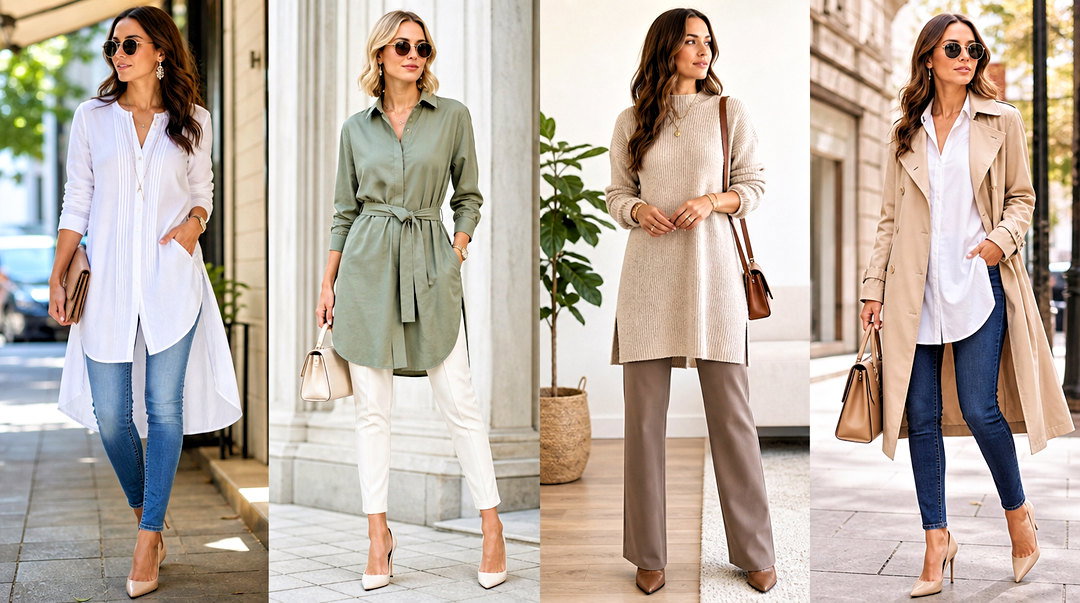
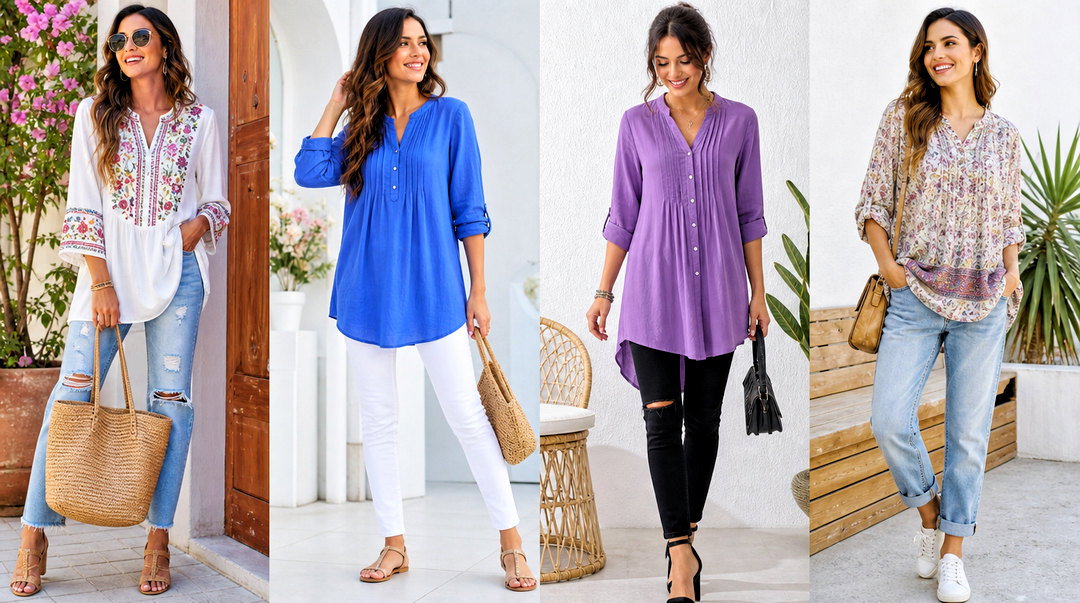
20. Tunic Top With Dark Jeans And Loafers
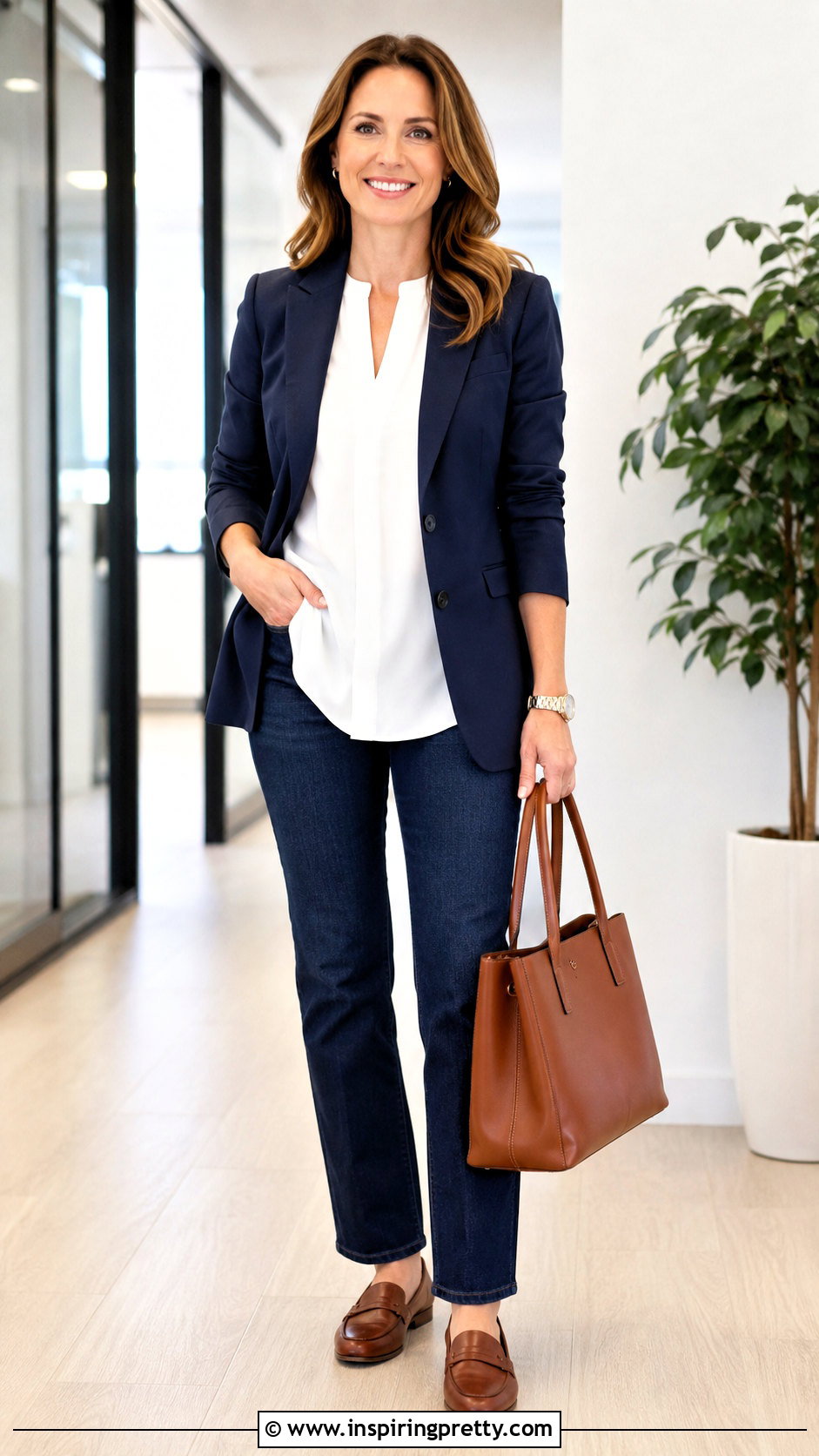
If your office allows denim, a tunic with dark jeans is a good Friday outfit, but it slides into weekend clothing quickly. The jeans should be a clean dark wash, straight or slim, with no fading and no rips. The tunic should be a woven fabric that holds its shape through the day; a jersey tunic over jeans is a casual outfit, not a work one. Loafers do most of the work of making denim office-ready, and a blazer adds formality if a meeting appears. Make sure the jeans fit smoothly at the waist and hip, because any bunching shows as ridges under a longer top. Pressed tunic, polished shoes: that's the difference.
Office Fabrics That Still Look Pressed After Lunch
A tunic has more fabric than a regular blouse, so it shows creases, pilling and shine more than a shorter top would. This is how the common work fabrics behave over an eight-hour day, from my own fittings and laundry experience.
Crepe and polyester-crepe blends
These are the easiest. The grainy surface hides sitting creases and falls straight, which is why so many of the looks above use it. Most blends wash on a gentle cycle and need only a quick steam.
Cotton poplin and shirting
Crisp and very office-like, but it creases where you sit. Hang it to dry and iron it while slightly damp. A small amount of elastane in the blend reduces creasing noticeably.
Fine knits
Warm and comfortable, but they pill where your arms and bag strap rub. Wash inside out, dry flat, and take the pills off with a fabric shaver before they spread. Never hang a knit tunic; its own weight stretches the shoulders.
Linen and satin
Both need more care. Linen blends crease less than pure linen. Satin shows water marks and sweat, so wear a camisole under it and keep it for cooler days or shorter meetings.
If you're unsure about a new tunic, crush a corner of the hem in your fist for ten seconds in the shop. If it springs back, it will survive the commute.
Two Pairs of Trousers Will Carry Most of This List
If you're building a tunic work wardrobe from scratch, buy the trousers first. A slim black ankle pant and one straight pair in navy or gray will sit under almost every top here, and a pair of dark jeans covers Fridays. Then add tunics in fabrics that hold their shape, crepe, poplin and fine knit, and check every one for hem length while you're sitting, not standing. Loafers, pointed flats and slim ankle boots cover your shoes. Start with solids, add one print and one color-block piece, and you'll have more combinations than you have workdays.
Related posts:


Leave a Reply